Why a Positive Food Allergy Test Doesn’t Always Mean Your Child Has an Allergy
When a child feels unwell or distressed after eating, parents want answers. For many families, testing feels like the most natural path to a diagnosis and the appropriate food allergy care. However, allergy diagnosis is rarely as clear-cut as a positive or negative result. In fact, understanding what the results really mean can be just as important as the test itself.
First Signs Your Child May Need Food Allergy Testing
Your child breaks out in hives after dinner. Maybe their lips swell. Maybe they vomit, develop a rash, or start coughing after eating something they’ve had before. For many parents, the next step isn’t always clear. You don’t care what you have to do, as long as your child is safe and you don’t have to watch them suffer again.
As you try to figure out why this has happened, one of the questions you ask yourself will be: Was that a food allergy? Finding the answer would involve food allergy testing, but understand that there’s more to a diagnosis than a test result.
What Your Child’s Food Allergy Test Results Really Mean
In fact, a positive test does not always mean that your child has a food allergy. At the same time, a negative test result is actually quite definitive—it can rule out an allergy with 90% certainty. When test results are interpreted without looking at the full picture of your child’s health with insights from an expert, you may inadvertently draw the wrong conclusions and miss the real cause of your child’s symptoms. In many cases, people will end up avoiding foods that are actually safe.
Confusion in these situations is more common than you think. The CDC’s 2024 National Health Interview Survey found that 5.3% of children in the United States have a diagnosed food allergy. That may not seem like a lot, but it is. And as awareness of these issues grows, so does the number of families who want to understand symptoms, test panels, and why they get conflicting advice.
Food allergy tests alone cannot be relied upon as the sole basis for making a diagnosis. Tests are simply tools. The diagnosis comes from putting the test results together with your child’s symptoms, medical history, and sometimes, the additional testing required under a specialist’s supervision.
If you’re a parent living in the DFW area and you’re trying your best to figure out what your child’s test results mean, here’s what you need to know.
When Should a Child Be Tested for Food Allergies?
Not every stomach ache, rash, or picky eating phase points to a food allergy. But for some children, considering food allergy testing makes sense.
It may be time to schedule testing if your child has had the following.
- Hives, swelling, or redness after eating a specific food.
- Vomiting, stomach pain, or diarrhea shortly after meals.
- Wheezing, coughing, throat tightness, or trouble breathing after eating.
- Persistent eczema that does not improve with standard treatment.
- A previous mild reaction that you were unsure how to interpret.
- A family history of asthma, food allergies, or eczema, along with suspicious symptoms.
Food allergies are especially common among infants and young children—and that doesn’t mean an allergy cannot develop later. A teenager might end up reacting to a food they were previously able to eat. That’s why we never make a diagnosis based on symptoms alone.
Main Types of Pediatric Food Allergy Tests
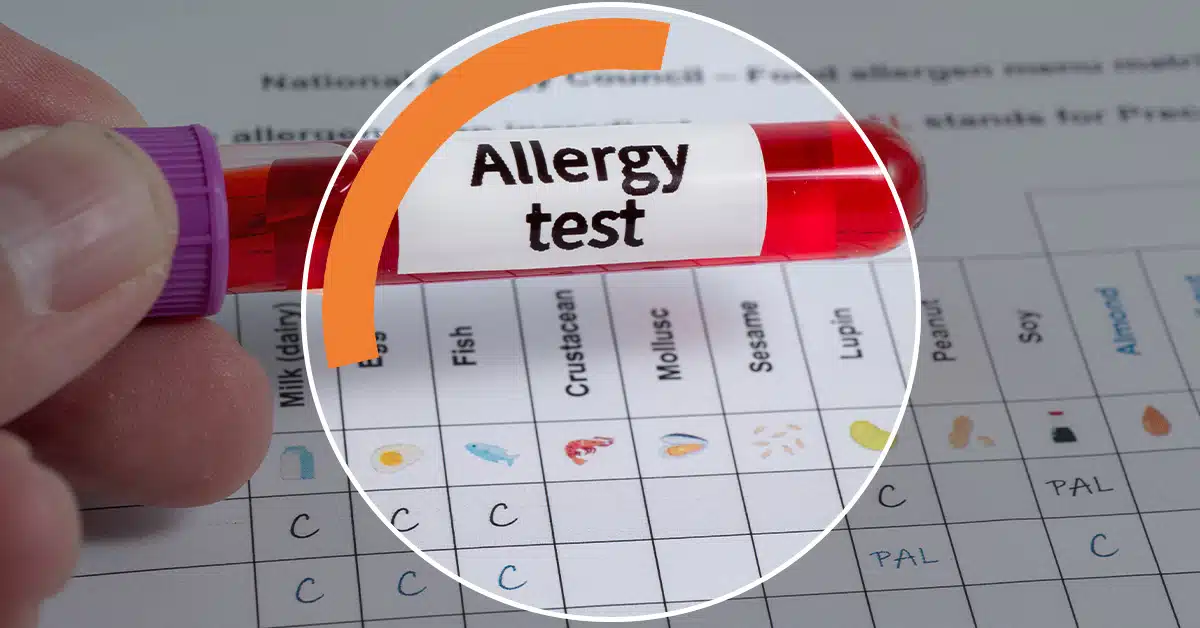
Food allergy specialists use a few different tools to evaluate whether a child may have a true allergy. Each method tells part of the story; no test should be used in isolation.
1. Skin Prick Test
A skin prick test is one of the most common tests in food allergy evaluation, and is used by specialists to help determine what might be happening. The test involves a small drop of allergen being placed directly on the skin, usually on the arm or back. Then, the skin is lightly pricked so the substance can enter the surface layer and interact.
If your child is sensitized to that food, you’ll see a small, raised red bump (referred to as a wheal) within about 15 to 20 minutes. When your child has no visible reaction to the sample, you’ll know that it’s highly likely they are not allergic to that food.
This test is quick to administer, widely used, and often well-tolerated by children. It’s helpful because it gives the allergist immediate feedback. The skin prick test can be very useful when paired with a detailed symptom history.
Still, it has limits. A positive skin prick test means that the immune system recognizes that food. It does not prove your child will have a real allergic reaction when they eat it. In other words, sensitization and allergy are not the same thing.
2. IgE Blood Test
An IgE blood test measures the amount of allergen-specific immunoglobulin E in your child’s blood. These antibodies can suggest that the immune system is reacting to certain foods.
This can be useful when skin testing is not practical, such as when a child has extensive eczema or cannot stop taking antihistamines. But this is also where many families get confused….
A positive IgE blood test does not automatically equal a food allergy. False positives are common, especially when broad panels test many foods at once without a clear reason. A child may come back “positive” for several foods they have eaten safely before, and that can lead to unnecessary restrictions and a lot of stress.
The numbers on the lab report matter less than the context surrounding it. For instance, what food was eaten? How much? How quickly did symptoms appear? What actually happened afterward? That clinical context is what makes the test meaningful.
3. Oral Food Challenge
The oral food challenge is seen as the best option for diagnosing a food allergy.
During this test, your child will eat gradually increasing amounts of the suspected allergen while under close medical supervision. The care team watches for any sign of a reaction and is fully prepared to treat symptoms if they occur.
This is the test that answers the question most parents are actually asking: What happens if my child eats the food?
Oral food challenges are often used when skin or blood test results are unclear, when there is a history that does not match the testing, or when a specialist wants to see whether a child has outgrown an allergy. This is especially common with milk and egg allergies, which some children do outgrow over time.
Because of the possibility of a reaction, an oral food challenge should only be done in a clinical setting. It should never be attempted at home.
4. Basophil Activation Test (BAT)
The basophil activation test, or BAT, is a more advanced blood test that looks at how basophils, a type of white blood cell, respond when exposed to a suspected allergen.
This matters because BAT can help distinguish between simple sensitization and a more likely true allergic response. That makes it especially helpful in complex cases where standard testing is unclear, conflicting, or potentially misleading.
For families who have been stuck in the gray area between “positive test” and “actual allergy,” BAT can offer another layer of clarity.
Safe2Bite offers BAT as part of its diagnostic approach, which is a meaningful differentiator for families looking for more specialized food allergy evaluation in the DFW area.

Why a Positive Allergy Test Result Can Be Misleading
Many parents get tripped up because they see a “positive” test result. A food allergy test result is not a stand-alone diagnosis, it is one piece of information. Without taking a careful history and an expert interpretation, that information can be misunderstood.
One common example is seen with the broad pediatric blood panel. For example: A child gets tested for 20 or 30 foods at once and comes back with several positive results. The family is then told, directly or indirectly, to avoid all of them.
That can create major problems. Parents may remove foods unnecessarily, and children may face nutritional gaps, social stress, and anxiety around meals. And in some cases, the foods being avoided were never causing symptoms in the first place.
The correct diagnostic process is much more targeted, and a food allergy specialist typically looks at the following.
- Your child’s reaction history.
- The timing and severity of symptoms.
- Related conditions such as eczema or asthma.
- Targeted testing based on likely triggers.
- Whether an oral food challenge is needed for confirmation.
Organizations, including the American Academy of Allergy, Asthma & Immunology and American College of Allergy, Asthma & Immunology emphasize that testing must be interpreted in the context of clinical history. A positive test alone is rarely enough reason to label a child with a lifelong food allergy.
Food Allergy Tests to Avoid
Not every test marketed to parents is clinically valid. In fact, some tests can create more confusion than clarity.
Consider avoiding these tests.
- IgG food sensitivity tests sold online or through wellness clinics.
- Hair analysis for food reactions.
- Kinesiology or muscle testing.
- At-home finger-prick allergy panels without a specialist’s interpretation.
These tests are not considered reliable tools for diagnosing food allergies in children. In some cases they reflect food exposure rather than allergy, and in others, they have no scientific basis at all.
If a test can be ordered online without a medical evaluation and mailed straight to your home, it is unlikely to give you the clear, clinically useful answer you need.
Why Food Allergy Specialist Care Matters
Parents are often told to “just get tested,” but the real value is not in the test itself, it’s in the interpretation.
A board-certified food allergy specialist knows how to tell the difference between a meaningful result and an irrelevant one. They know when a positive test likely reflects true risk, when a result may be a false positive, and when an oral food challenge is the safest next step.
That level of expertise matters, especially when the goal is not just collecting data, but helping your family know what is actually safe, what needs to be avoided, and what comes next.
It also matters in how your child experiences the process. Pediatric-focused allergy teams know how to test and examine infants, toddlers, and older children in ways that reduce fear and build trust. From how testing is explained to how procedures are performed, the goal is to help children feel calm, comfortable and supported throughout the evaluation.
For many parents, that clarity is what finally lowers the anxiety.

Food Allergy Testing for Children in DFW
If your child has had a reaction you suspect may be food-related, the next best step is to not guess, not assume—and it’s also not ordering a broad allergy panel test on your own. Rather, it is to get a proper evaluation from a specialist who focuses on food allergy diagnosis and care.
At Safe2Bite, families receive comprehensive food allergy testing and support from a team dedicated specifically to this area of medicine. As a pediatric allergist and a mom to children with food allergies, Dr. Mireku has both a unique perspective and a practical understanding of what families carry with them when they walk through the clinic doors: uncertainty, conflicting advice, fear—and a deep desire for real answers.
“Very informative and listened to all my concerns. My oldest was so nervous about this round of testing. Dr. Mireku made my kids so comfortable. No tears, all happy faces.”
— Parent Testimonial
After your child experiences a sudden reaction to food, it’s understandable to feel distressed and full of questions. Answers concerning what triggered the reaction, how serious it may be, and whether it is truly an allergy can give much-needed reassurance. With an appointment at one of our DFW food allergy treatment centers, you can understand what is happening, avoid unnecessary diet restrictions, and help your child receive the best long-term care.
Expert Food Allergy Testing for Children in North Texas
Safe2Bite offers food allergy diagnosis, testing and treatment, including immunotherapy, at three convenient DFW locations in Southlake, McKinney and Frisco. If your child has had a reaction, it’s time to get clarity. Call (469) 916-5504, or book an appointment with Safe2Bite and get answers you can actually trust.
